A snapped torsion spring is the number-one reason a DFW garage door strands a family on the way out the door. But springs almost never break without warning — they give you 3 to 6 months of hints if you know what to listen and look for. Here are the seven signs we tell every Steward customer to watch for.
1. The Door Feels Heavier When You Lift It Manually
Pop the red emergency-release cord (with the door closed) and lift the door by hand. A properly balanced door should feel weightless at the halfway point and stay put when you let go. If it feels heavy, or it drifts back down on its own, the spring has lost tension. This is the earliest and most reliable warning — usually 2-3 months before the actual break.
2. The Opener Strains or Groans
Your LiftMaster, Chamberlain, or Genie opener is a guide, not a lifter. The spring does the heavy work. When the spring weakens, the opener has to compensate — you'll hear it strain, take longer per cycle, or pause mid-lift. If your normally-quiet belt-drive suddenly sounds like a chain-drive, the spring is the reason nine times out of ten.
3. Gaps Appear Between Spring Coils
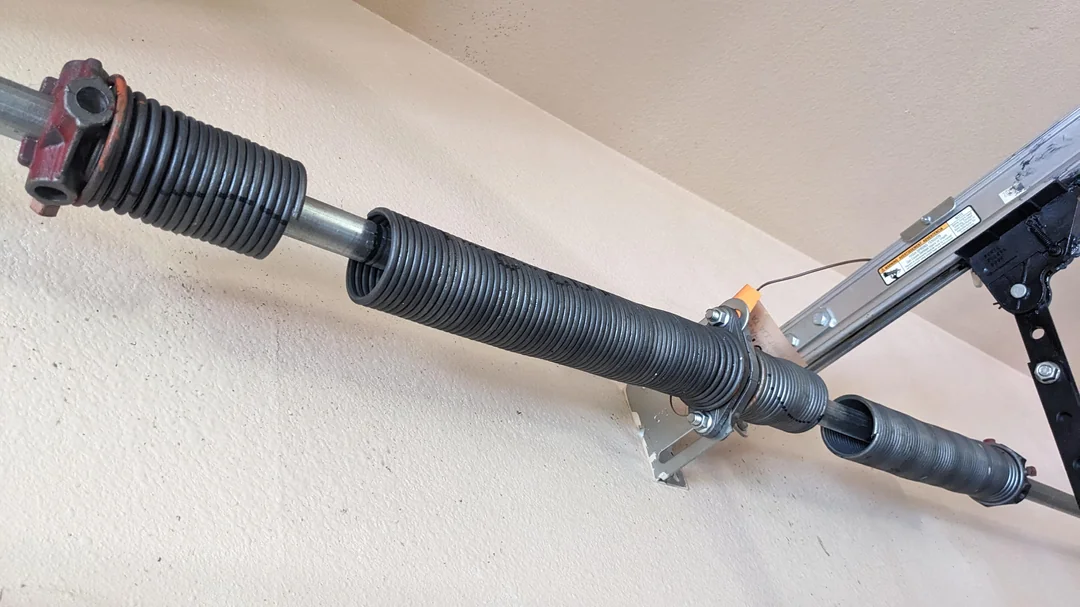
Look up at the spring above the door. A healthy torsion spring has coils that touch each other tightly along the entire length. A gap of even 1-2 inches means the spring has already partially failed internally — the wire has fractured but hasn't fully separated yet. When you see this, the spring is done. Book service the same week.
4. Rust Flakes on the Floor Below the Spring
Rust means the spring's protective coating has worn through and the steel underneath is corroding. Corroded springs snap unpredictably — a spring that would have lasted another year with clean coils might snap next Tuesday if it's rusted. In DFW, humidity from an attached-garage HVAC and Texas thunderstorm rain driving through weatherstrip gaps are the main causes.
5. Loud Bang From the Garage With Nothing Falling
You're in the house and hear what sounds like a gunshot from the garage, but nothing is broken. That's your spring snapping. Do not run the opener — the motor will burn out trying to lift a 200-lb door with no counterbalance. See our full guide: Broken Garage Door Spring? What to Do Right Now.
6. The Door Opens Halfway and Stops
If the opener starts to lift the door, gets to about 3-4 feet up, and then stops or reverses, the opener has hit its force limit because the spring isn't helping enough. This means the spring is on its last legs. Do not keep hitting the button — you'll blow the opener capacitor or gear.
7. One Side of the Door Rises Faster Than the Other
This is a common sign on double-spring systems (typical on 16-foot doors). One spring has weakened faster than the other, so one side of the door lifts before the other. You'll see the door go crooked mid-lift. When one spring goes, the other is usually within 6 months of failing too — that's why we replace both springs as a pair.
The Lifespan Math Every DFW Homeowner Should Know
Standard torsion springs are rated for 10,000 cycles (one cycle = one open plus one close). A family that opens the garage 4 times a day hits 10,000 cycles in about 7 years. A busy family with teenagers and two working parents can hit it in 5 years. Texas heat cycling — 130°F attic in July, 30°F night in January — accelerates fatigue.
Upgrading to 25,000-cycle high-cycle springs at replacement runs $500–$850 installed (vs. $300–$700 for a standard 10K pair) and roughly doubles service life. For most DFW homeowners this is the single best ROI garage door upgrade you can make.
What to Do When You See a Warning Sign
Do not try to adjust a torsion spring yourself — wound springs store the energy equivalent of a small explosion. Spring work is one of the leading causes of DIY emergency-room visits in home repair. Book a same-week service call. A Steward tech can inspect and replace a spring pair in about 45-60 minutes for a standard 7-foot door.