When you buy garage door springs, you'll see numbers like 10,000 cycles or 25,000 cycles. Here's what those numbers actually mean and how to translate them into years of service life for your household.
What's a "Cycle"?
One cycle = one full open + one full close. Not just an open. Not the door moving partway. Full open then full close = one cycle.
Cycle Ratings Explained
| Cycle rating | Wire gauge (typical) | Cost premium (over 10K) |
|---|---|---|
| 10,000 | 0.225" – 0.243" | Baseline |
| 25,000 | 0.250" | +$100–$150 |
| 50,000 | 0.263" | +$250–$400 |
| 100,000 | 0.283" (commercial) | +$350–$800 |
How to Estimate Your Household's Cycle Count
Add up your typical daily garage door cycles:
- Every time a car leaves and returns = 2 cycles
- Teenager who comes and goes = another 4–6/day
- Grocery trips = 2 cycles each
- Dog walks through garage = 2 cycles each
- Trash/mail runs = 2 cycles each
Multiply by 365 to get annual cycles.
Real Household Examples
| Household type | Daily cycles | Annual cycles | 10K spring lasts | 25K spring lasts |
|---|---|---|---|---|
| Single retiree | 2 | ~730 | 13–14 yr | 34+ yr |
| Working couple, no kids | 4 | ~1,460 | 7 yr | 17 yr |
| Family of 4, 2 cars, teen driver | 8 | ~2,900 | 3.5 yr | 8.5 yr |
| Family of 5 with dog + workshop | 12 | ~4,400 | 2.3 yr | 5.7 yr |
Add DFW heat as a 20–30% penalty and adjust downward. A busy family in DFW can burn through standard 10K springs in under 3 years.
When to Upgrade to 25K
Do the math and if a standard 10K spring won't make it 7–8 years for your household, the $150 upgrade to 25K almost always pays off. You avoid one full replacement service call ($250–$500) and the risk of a snap at an inconvenient moment.
Rule of thumb we use with customers:
- Under 3 daily cycles: 10K is fine.
- 3–6 daily cycles: 25K worth it.
- 7+ daily cycles: 25K minimum, consider 50K.
- Workshop, gym, second business: 50K.
Wire Gauge = Spring Strength
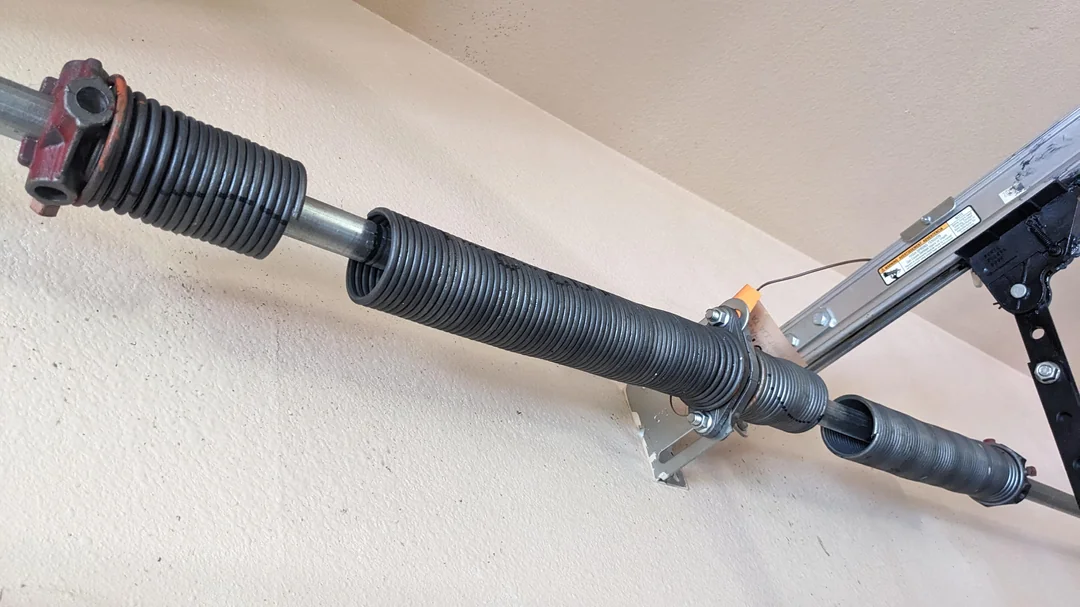
Cycle rating correlates with wire diameter. Thicker wire holds up to more cycles. The difference is small — 0.243" vs. 0.263" — but it means significantly more steel taking the load. A 25K spring isn't just a 10K spring "rated" higher; it's a physically bigger, heavier spring.
Should I Just Get 50K?
You can. It'll last longer. But 50K springs are noticeably heavier, sometimes require a heavier torsion shaft, and add hardware complexity. For most residential DFW households, 25K is the sweet spot. 50K makes sense for very high-use garages or if you want a truly "set and forget" install.
The Bottom Line
Cycle rating isn't a marketing term — it's a physical fatigue rating on the steel. Estimate your household cycles, multiply by DFW heat factor, and choose accordingly. In our experience: 25K high-cycle springs are worth it for 80% of DFW families.