The hardest part of comparing garage door quotes isn't the number at the bottom — it's that quote A and quote B are rarely describing the same job. One bid might include a Clopay Gallery insulated steel door, matched-pair high-cycle torsion springs, a new LiftMaster belt-drive opener, haul-away, and a workmanship warranty. Another might include the door and brackets and nothing else — and still arrive at a “competitive” total by leaving out $800 of hardware and labor you'll owe later.
A real install quote has ten line items. Here's what each one is, why it matters, and what a complete DFW quote should look like end-to-end.
1. The Door Itself
The first line should name the brand, model line, size, insulation construction, color, and window option on a single spec row — not a vague “insulated steel garage door.” A real spec reads like:
Clopay Gallery Collection, 16×7, 2-layer insulated steel (polystyrene, R-9.0), 25-gauge, Ultra-Grain finish in Medium Oak, Stockton top-section windows with clear glass.
Three details to look for:
- Steel gauge: lower number = thicker steel. 24 or 25 gauge is standard for premium insulated residential; 27 and 28 gauge are builder-grade and dent more easily in hail.
- Insulation construction: polyurethane (Clopay Intellicore, Amarr HDi) packs more R-value per inch and bonds the steel skins together, making the door stiffer and quieter. Polystyrene (foam board sandwich) is less expensive, slightly less insulating, and more common at the mid-tier.
- Finish type: standard painted vs. wood-grain overlay (Ultra-Grain, Accent Woodtones). Wood-grain finishes add $200–$600 to the door, and HOA-governed neighborhoods usually require them.
2. Hardware Package
This is where lowball quotes hide. A complete hardware line should spell out:
- Torsion springs, sized to the finished door's weight (not the opening size), rated 10,000 cycles standard or 25,000+ cycles for high-cycle upgrade
- Lift cables, matched pair, correctly sized for door height
- Cable drums, matched to spring size and drum groove count
- Rollers — typically 10-ball sealed-bearing nylon on a premium install (long-life, quiet), vs. steel wheel rollers on a builder-grade bid
- Hinges, brackets, and strut, including a reinforcement strut on the top section if an opener is attached
A quote that just says “standard hardware included” is incomplete. Ask for the hardware line to be broken out so you can see what grade of rollers and spring cycle rating you're actually getting.
3. Weatherseal
Four seals, not one:
- Bottom seal (U-shaped vinyl or rubber astragal) — the one most homeowners picture
- Perimeter stop molding with integrated vinyl flap, running up both jambs and across the header
- Section-to-section joint seals — thin V-shaped weatherstripping between panels (standard on insulated doors)
- Threshold seal (optional) — a floor-mounted strip that bridges driveway slope and keeps blowing rain out
A premium install replaces all four when the old door is torn out. A budget quote often reuses the stop molding (saving the installer 20 minutes) and only replaces the bottom seal.
4. Tracks, Brackets, and Lift Style
The tracks are two assemblies — vertical (floor to ceiling) and horizontal (ceiling run back into the garage) — joined by a radius curve. On a replacement install, these should always be new: reusing old tracks introduces alignment problems and voids the manufacturer warranty on most door lines.
The quote should also name the lift style:
- Standard lift — horizontal track parallel to the ceiling, ~15 inches of headroom required (the DFW default)
- Low headroom — dual-track geometry for garages with 8 inches or less of clearance above the opening
- High lift — vertical track extends 2–4 feet above the opening before the horizontal run (common in modern DFW builds with 9′ or 10′ ceilings; opens the ceiling for storage racks)
- Vertical lift — door travels straight up with no horizontal run (rare in residential; used in warehouses)
High-lift conversions add $400–$800 to a standard install because of the extra track, longer cables, and the drum change needed to accommodate the vertical travel.
5. Opener (If You're Replacing It)
If the opener is coming out at the same time, it belongs on its own line with the brand, model number, drive type, horsepower, and included accessories:
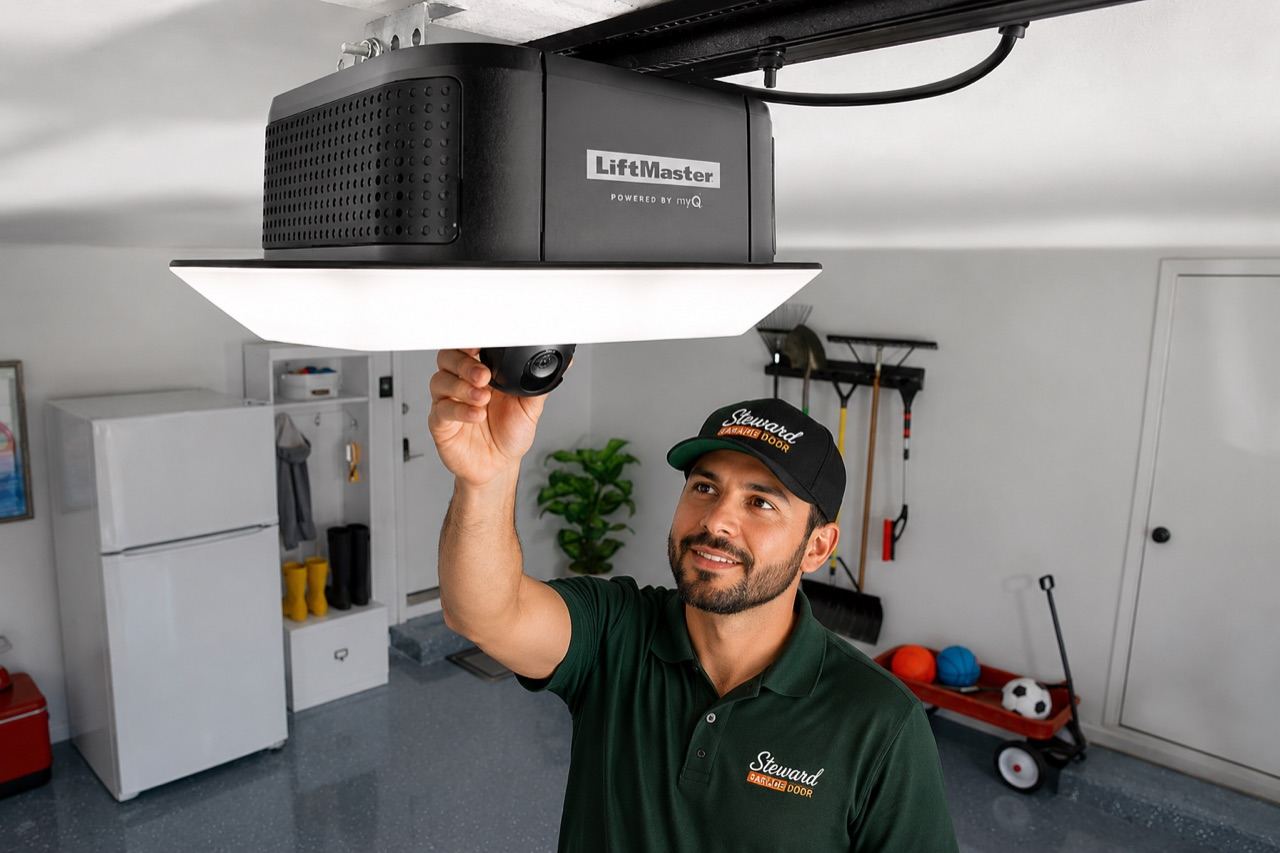
LiftMaster 8550W Elite Series belt-drive opener, 3/4 HP equivalent, battery backup, (2) 893MAX 3-button visor remotes, (1) 877MAX wireless keypad, (1) MyQ Smart Hub.
Three things to confirm with your installer:
- Photo-eye safety sensors: included with every opener sold — they're a required part of the opener itself, not an add-on. If a quote lists them as an extra line item, that's an upsell flag.
- Reinforcement strut on the top section of the door (required by every opener manufacturer; voids opener warranty if the door was built without one and no strut is added).
- Working wall-button and remote programming before the installer leaves. Takes five minutes; some crews skip it.
6. Tear-Out, Haul-Away, and Disposal
The old door, old tracks, old springs, old opener (if replacing), and all packaging from the new door should leave with the installer. On a premium quote this is a standalone line and reads “included.” On a budget quote it's sometimes an upcharge of $50–$200. Either way, confirm it's on paper — a 400-pound rusted-out door sitting in your driveway is not a surprise you want.
7. Labor
Labor should be its own line, even on a flat-rate quote. The industry-standard install times:
| Scope | Typical labor time |
|---|---|
| Single-car door, no opener change | 3–5 hours |
| Two-car door (16×7), no opener change | 4–6 hours |
| Two-car door + new opener | 6–8 hours |
| Full-view aluminum & glass | +2 hours (glass handling) |
| High-lift conversion | +2–3 hours (track rework) |
| Custom wood or Canyon Ridge composite | +2–3 hours (weight & finish handling) |
Labor includes bracket layout and anchoring, torsion-tube assembly, winding and tensioning the springs, cable routing, panel-by-panel door assembly, opener installation and travel/force programming, and the balance and cycle test at the end.
8. Permit (If Required)
Most DFW cities — Dallas, Fort Worth, Plano, Frisco, Southlake, Grapevine, Allen, McKinney, Flower Mound — do not require a permit for a same-opening cosmetic replacement when the header and framing stay as-is. You do need a permit when:
- The opening size is changing (going from one-car to two-car, or widening an opening)
- The header is being modified or replaced
- Structural work is involved (framing, lintel, or masonry change)
- The property is in a historic district with its own review process
When a permit is needed, it belongs on the quote as its own line with the city's fee listed. Steward files the permit for you — you don't chase forms — and the cost shows transparently rather than being folded into labor.
9. Warranties
Two warranties should be named explicitly on the quote:
- Manufacturer parts warranty: Clopay, Amarr, CHI, Wayne Dalton, and LiftMaster each publish their own. Terms vary by line — sections and hardware are typically 1–7 years, insulation delamination is often lifetime, and finish/paint is 1–5 years. The quote should name the specific warranty document, not say “manufacturer warranty included.”
- Workmanship warranty: the installer's own coverage on labor. Steward backs installation workmanship for life while you remain a Care Plan member; non-member installs carry a 1-year workmanship warranty standard.
10. Final Walkthrough and User Demonstration
Before the installer leaves, you should get:
- A balance test (door disengaged from opener, lifted halfway by hand, holds position)
- A full cycle test with the opener (up, down, auto-reverse on the photo-eye)
- Remote and keypad programming demonstrated with you holding them
- The MyQ app paired to your phone (if the opener supports Wi-Fi)
- Written start/finish date, model numbers, and warranty on a document in your hand — not just emailed later
What a Complete DFW Install Quote Actually Totals
With all ten line items present, a premium DFW install typically falls in these ranges:
| Door class | Installed price |
|---|---|
| Basic single-layer steel (uninsulated) | $1,800–$2,600 |
| Insulated steel R-9 (Gallery, Lincoln) | $2,400–$3,800 |
| Premium insulated R-18 (Gallery Ultra-Grain) | $3,200–$4,800 |
| Carriage-house steel (Amarr Classica) | $3,500–$5,500 |
| Carriage-house w/ windows (Clopay Coachman) | $3,800–$6,500 |
| Full-view aluminum & glass (Avante) | $6,000–$12,000 |
| Custom wood / Canyon Ridge composite | $7,500–$18,000 |
Add a new opener if you're replacing it:
- LiftMaster 8355W belt-drive: +$700–$1,100 installed
- LiftMaster 8550W belt-drive w/ battery backup: +$900–$1,400 installed
- LiftMaster 8500W wall-mount jackshaft: +$1,200–$1,800 installed
A written estimate below the floor of these ranges almost always means something is missing from the scope — usually the hardware grade, the haul-away, or the warranty.
Red Flags in a Quote
- No brand, model, or spec on the door line
- “Standard hardware included” with no roller type or spring cycle rating
- Opener listed by horsepower only, no model number
- No workmanship warranty, or a vague “we stand behind our work” without a term
- Lump-sum total with no itemized sheet available
- Verbal quote only, with the number “good for today only”
- Deposit demanded in cash before any paperwork is signed
A legitimate DFW installer will put the entire scope in writing before you commit to anything. If a bidder won't, that's your answer.
The Steward Approach
Every Steward quote lists the ten line items above by name, with model numbers, hardware grades, warranty terms, and a start/finish timeline. The quote is itemized by default and valid for 30 days. Service calls are $0 — no trip fee, no diagnostic charge — and the quote itself is free whether you book or not. If you have a competitor's bid in hand and want a side-by-side read, bring it. We'll show you what's included on paper vs. what's included in reality.