Homeowners ask this question every week: "how long should my garage door last?" The honest answer is that a garage door isn't one thing — it's a dozen parts, each with its own lifespan. Some outlast the house; some die every 5 years. Here's the real number for each part in Texas conditions.
The Door Panels: 25-30 Years
A well-installed 24- or 25-gauge steel garage door from Clopay, Amarr, Wayne Dalton, or C.H.I. Overhead Doors will physically last 25-30 years. What kills a door before then is almost always cosmetic — hail dents, sun-fading paint, or someone backing into it — not structural failure. Insulated doors last as long as uninsulated because the steel skin is the load-bearing part.
Wood doors: shorter, 15-25 years depending on paint/stain maintenance and sun exposure. The Texas sun is brutal on wood.
Torsion Springs: 5-12 Years
The single fastest-wearing part. Standard 10,000-cycle springs last:
- Heavy use (5+ cycles/day): 5-6 years
- Average use (3-4 cycles/day): 7-9 years
- Light use (1-2 cycles/day): 10-12 years
Upgrading to 25,000-cycle high-cycle springs doubles all of those numbers; DFW installed pricing runs $500–$850 for the pair (vs. $300–$700 standard). If you have teenagers or work from home, this pays for itself before the first replacement.
Lift Cables: 8-15 Years
Steel lift cables that connect the bottom brackets to the drums typically outlast one spring cycle but not two. Realistic replacement window is 8-15 years — longer if the door and springs are in good balance, shorter if a bent track or over-tensioned spring frays them prematurely. Cables should always be replaced in matched pairs.
Rollers: 5-15 Years (Depending on Type)
The biggest lifespan swing on the whole door depending on which type you have:
- Builder-grade steel rollers with sleeve bearings: 5-7 years before they start grinding
- Steel rollers with ball bearings: 8-10 years
- Nylon rollers with sealed ball bearings: 12-15 years, often longer
See our full breakdown: Nylon vs. Steel Garage Door Rollers.
Hinges: 15-25 Years
Steel hinges (numbered 1 through 4 for their position on the door) rarely fail on their own — they usually get replaced because a door came off track and bent them, not because they wore out. Expect 15-25 years in normal service.
Weatherstripping: 3-7 Years
The rubber bottom seal and vinyl side/top seals take direct sun, driven rain, and freeze-thaw cycles every year. In DFW:
- Bottom seal (T-astragal or U-shape): 3-5 years before cracking
- Side and top vinyl seals: 5-7 years
Torn seals let heat into your garage and rain onto your opener. Cheap to replace — $22-$40 per bottom seal, $80-$130 installed for full perimeter.
The Opener: 10-20 Years
Depends heavily on brand and how well the door is maintained (an over-strained opener dies fast). Realistic:
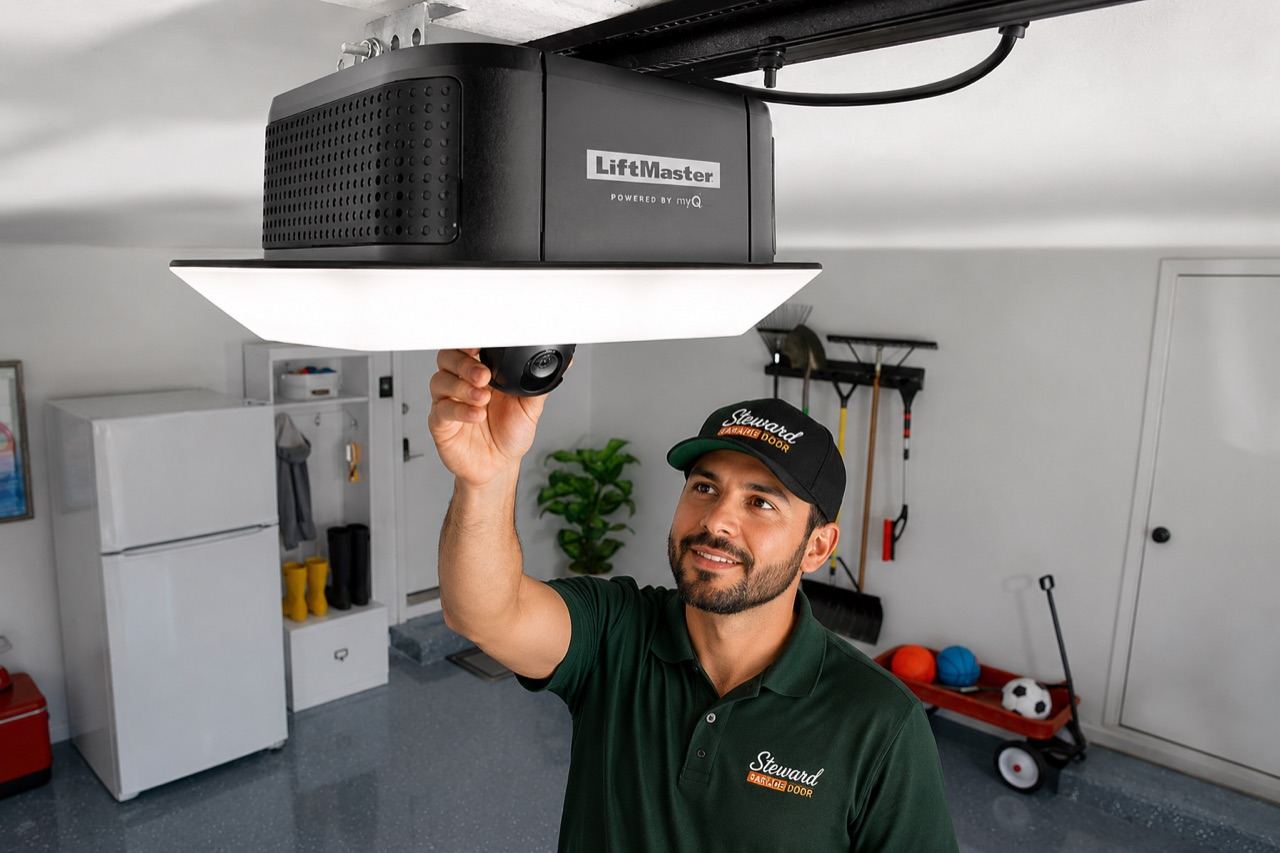
- LiftMaster and Chamberlain belt-drive: 15-20 years
- LiftMaster and Chamberlain chain-drive: 12-17 years
- Genie SilentMax belt: 12-15 years
- Craftsman and generic: 8-12 years
- Any opener installed with an undersized motor for the door: subtract 5-8 years
Individual opener parts that fail before the whole unit dies: capacitor (7-10 years), gear/sprocket (10-15 years), logic board (unpredictable, often storm-related in DFW).
The Track: 20-30 Years
Vertical and horizontal tracks are 14-gauge galvanized steel and rarely wear out — they get bent from a car impact or a door coming off track. If your tracks are clean and straight, they'll outlast the door panels.
Safety Sensors: 8-15 Years
The photo-eye sensors at the bottom of each track are simple LEDs and photoreceptors. They fail from lawnmower knocks, wire chew (from mice in the garage), or corrosion of the wire connections. Standalone sensor pair is $60-$120 installed — usually no need to replace the whole opener.
What This Means for Planning
If you buy a new door today, expect a realistic timeline like this:
- Year 5-7: First spring replacement
- Year 6: Weatherstrip replacement
- Year 8: Roller replacement (if builder-grade came stock)
- Year 10-15: Opener replacement
- Year 12-15: Second spring replacement, cable replacement
- Year 25-30: Door panel replacement (or cosmetic if hail hits earlier)
Total lifetime cost of maintenance across 25 years: roughly $2,800-$4,500. Compared to $2,000-$3,700 for a full new door install today, the math strongly favors maintaining a good door.