
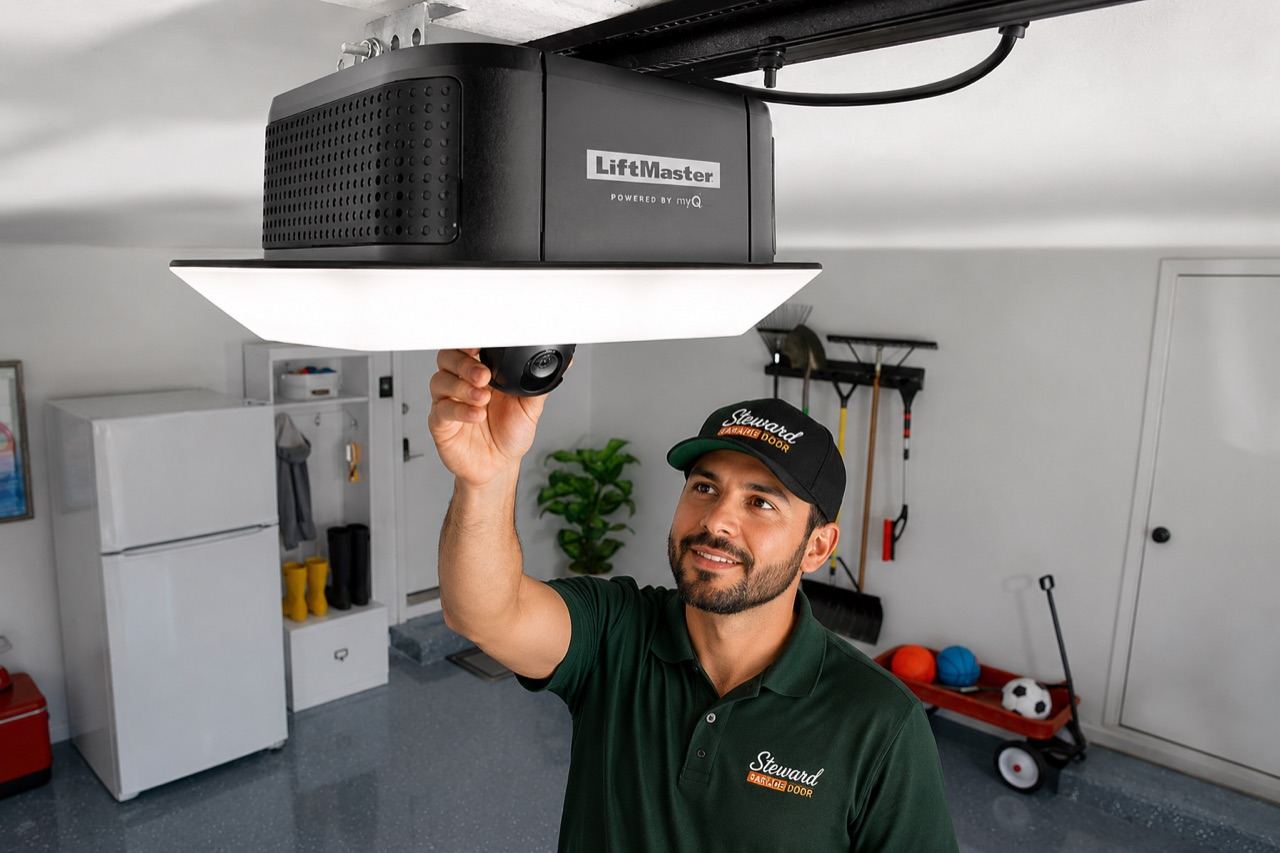
Walk into Home Depot and you'll see LiftMaster openers labeled 1/2 HP, 3/4 HP, and various DC wall-mount units. Get this call wrong and you either overpay for horsepower you'll never use, or you install an underpowered motor that burns out in 6 years. Here's the honest sizing framework a DFW installer uses.
Important note before we start: Many of the specific model numbers below are LiftMaster models that have been discontinued in the last few years but are still on tens of thousands of DFW garages. They're referenced so you can identify what's on your ceiling. Always check liftmaster.com for current models before ordering a replacement.
The Real Question: Door Weight, Not HP
Horsepower matters far less than how hard your opener has to work per cycle. That depends on door weight. A modern well-insulated double-car door can weigh 300 lbs. A single-car uninsulated door can be under 100 lbs. Same LiftMaster motor — wildly different working life.
Rough door weights we see in DFW:
- 9x7 single-car, uninsulated steel: 80–110 lbs
- 9x7 single-car, insulated (R-12): 130–170 lbs
- 16x7 double-car, uninsulated steel: 140–180 lbs
- 16x7 double-car, insulated (R-12): 200–260 lbs
- 16x8 double-car with wood cladding or full-view glass: 280–380 lbs
- 18x8 carriage house style (Clopay Coachman, Amarr Classica): 320–450 lbs
1/2 HP LiftMaster Class
Half-horsepower AC belt-drive openers are the entry tier. Best fit for single-car doors and lighter double-cars. LiftMaster's 1/2 HP Wi-Fi units in the recent generation include the 8155W and the Premium Series 8355W — both AC belt drive, Wi-Fi enabled, and both discontinued. Sources: 8155W, 8355W.
3/4 HP LiftMaster Class
Three-quarter-horsepower openers are LiftMaster's mid tier — the right pick for standard 16x7 double-car doors, insulated or not. Recent-generation units include the 8557 (3/4 HP AC belt drive) and the 8587W (3/4 HP AC chain drive, Wi-Fi, now discontinued). Sources: 8557, 8587W.
The battery-backup DC belt-drive that many installers default to for premium jobs is the 8550W. It has integrated battery backup for power outages. Also discontinued in favor of newer SKUs — look for the current LiftMaster battery-backup belt-drive lineup for a modern equivalent. Source: 8550W.
Wall-Mount Jackshaft (LiftMaster 8500-Series)
The LiftMaster 8500 wall-mount jackshaft is a different animal — it bolts to the wall next to the door instead of the ceiling. It's a DC opener rated by lift capacity (up to 850 lbs door weight in the 8500W / 8500WLA / 8500WRGD family), not by HP. LiftMaster does not publish an HP figure for these units.
Right choice when you have:
- Vaulted or cathedral ceilings — no room for a ceiling rail.
- Bonus rooms above the garage — moving the motor off the ceiling reduces noise transmission into rooms above.
- Heavy or tall doors — carriage-house, wood, or full-view glass doors near or above 300 lbs.
Sources: 8500 wall-mount, 8500W.
What Never to Do
Never undersize. A 1/2 HP opener straining to lift a 250-lb door isn't "still working" — it's dying. Motor windings overheat, capacitors weaken, and you're replacing the opener years earlier than a properly-sized 3/4 HP or jackshaft would have lasted.
Never oversize either — a jackshaft on a 100-lb single-car door doesn't lift it any faster or better. You're paying for capacity you'll never use.
How to Actually Weigh Your Door (30 Seconds)
Pull the emergency release. Manually lift the door about 3 feet. Have someone slide a bathroom scale under the door and gently lower it onto the scale. That's the weight the opener sees per cycle. Match it to the manufacturer-published door-weight rating for the specific opener model you're considering — every current LiftMaster product page lists it.
Our Default DFW Recommendation
For most attached-garage DFW homes we default to a current LiftMaster battery-backup DC belt-drive in the 3/4 HP class — quiet enough for a bedroom above the garage, and battery-backed so a Texas summer power outage doesn't strand you. For carriage-house, wood, or full-view doors on Southlake, Westlake, and Highland Park builds, we default to the 8500-series wall-mount jackshaft. Prices vary by model; expect $800–$1,200 installed for a 3/4 HP battery-backup belt drive, and $1,200–$1,700 installed for the jackshaft.